The Intel 8080: Basis Processor that started the PC Revolution
The Intel 8080: The Basis Processor
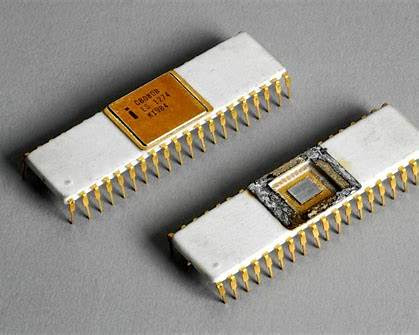
The 8080 became the foundation of early personal computing, inspired the creation of software companies, and influenced processor architectures that remain in use today. In many ways, the 8080 was the first microprocessor that made personal computers practical.
The World Before the 8080
In the early 1970s, computers were large, expensive machines found primarily in universities, government agencies, and major corporations. Even small "minicomputers" cost thousands of dollars and required specialized knowledge to operate.
Microprocessors were still a new concept. The Intel 4004 and later the Intel 8008 showed promise, but they were limited in speed and capability. Engineers wanted a processor powerful enough to serve as the brain of a general-purpose computer.
Intel's answer was the 8080.
Released in April 1974, the new chip was significantly faster, easier to use, and capable of addressing much more memory than its predecessors. For many engineers and hobbyists, it was the first processor that felt like a "real computer" on a chip.
Technical Overview
The Intel 8080 was an 8-bit microprocessor, meaning it could process 8 bits of data at a time.
Key specifications included:
| Feature | Intel 8080 |
|---|---|
| Release Year | 1974 |
| Data Bus | 8-bit |
| Address Bus | 16-bit |
| Maximum Memory | 64 KB |
| Clock Speed | Up to 3.125 MHz |
| Package | 40-pin DIP |
| Technology | NMOS |
While these specifications appear tiny by modern standards, they represented a major leap forward in the 1970s.
The ability to access 64 kilobytes of memory was especially important because it allowed programmers to create much larger and more sophisticated applications than before.
Inside the Processor
To understand the importance of the 8080, it helps to examine how it worked internally.
The Registers
The processor contained several small storage locations called registers.
Among them were:
- Accumulator (A)
- B register
- C register
- D register
- E register
- H register
- L register
These registers held data temporarily while instructions were executed.
Programmers often used the H and L registers together as a memory pointer, allowing efficient access to data stored elsewhere in memory.
Arithmetic Logic Unit (ALU)
The ALU was responsible for mathematical and logical operations.
It could perform tasks such as:
- Addition
- Subtraction
- Comparison
- Logical AND
- Logical OR
- Exclusive OR (XOR)
Every calculation in a program eventually passed through this circuitry.
Though simple compared to modern CPUs, the ALU provided enough functionality to run operating systems, programming languages, and games.
Program Counter and Stack Pointer
Two important 16-bit registers controlled program execution:
Program Counter (PC)
This register stored the address of the next instruction to execute.
Stack Pointer (SP)
This register managed the stack, a special memory area used for subroutines and temporary data.
These features allowed programmers to create structured programs instead of long sequences of linear instructions.
Instruction Set
The 8080 supported a rich collection of machine instructions.
These instructions enabled:
- Data movement
- Arithmetic operations
- Conditional branching
- Subroutine calls
- Input/output communication
For programmers, this flexibility made the processor attractive for a wide range of applications.
A Look at the Silicon
One of the fascinating aspects of early processors is their simplicity compared to modern chips.
The 8080 contained only a few thousand transistors. Engineers could examine much of the processor's structure under a microscope and identify major functional blocks such as:
- Registers
- Control logic
- Arithmetic circuits
- Timing circuitry
Modern processors contain billions of transistors, making visual inspection nearly impossible.
The 8080 represents a period when the entire CPU could still be understood by a single engineer.
The Altair 8800 and the Birth of Personal Computing
The Intel 8080 might have remained just another successful processor if not for one machine: the Altair 8800.
Released in 1975, the Altair 8800 used the 8080 as its central processor.
For the first time, computer enthusiasts could purchase an affordable machine and program it themselves.
The Altair quickly became a sensation among hobbyists.
Its popularity sparked the formation of computer clubs, software development communities, and small technology companies.
Most importantly, two young programmers—Bill Gates + Paul Allen—developed a version of BASIC for the Altair.
That project became the first product of what would later become Microsoft.
Influence on Future Processors
The impact of the 8080 extended far beyond its own commercial success.
The Z80
Former Intel engineer Federico Faggin helped create the Zilog Z80.
The Z80 remained compatible with much of the 8080's software while adding new capabilities.
It became one of the most successful processors of the late 1970s and early 1980s and powered countless home computers.
Intel 8085
Intel refined the design into the Intel 8085, simplifying system design and reducing the amount of supporting hardware required.
The Road to x86
The lessons learned from the 8080 eventually contributed to the development of the Intel 8086.
The 8086 introduced the x86 architecture, which evolved into the processor family used by most desktop and laptop computers today.
Why the 8080 Matters
Many processors are technically impressive. Few change history.
The Intel 8080 accomplished several things simultaneously:
- It made affordable microcomputers possible.
- It became the heart of the first successful personal computers.
- It inspired a generation of programmers and engineers.
- It helped launch the software industry.
- It influenced processor designs for decades.
Without the 8080, the personal computer revolution would likely have arrived later and followed a very different path.
Conclusion
Fifty years after its introduction, the Intel 8080 remains one of the most important chips ever produced. The Intel 4004 proved that a CPU could be built on a single chip. Modern processors contain billions of transistors and execute billions of instructions per second, yet their lineage can be traced back through the x86 family to the era when a 40-pin ceramic package running at 2 MHz changed computing forever.
The 8080 bridged the gap between experimental microprocessors and practical personal computers, earning its place as one of the most influential chips in the history of technology. Speaking of computing history, the 4004 proved that a microprocessor was possible. The 8080 proved that it could change the world.